
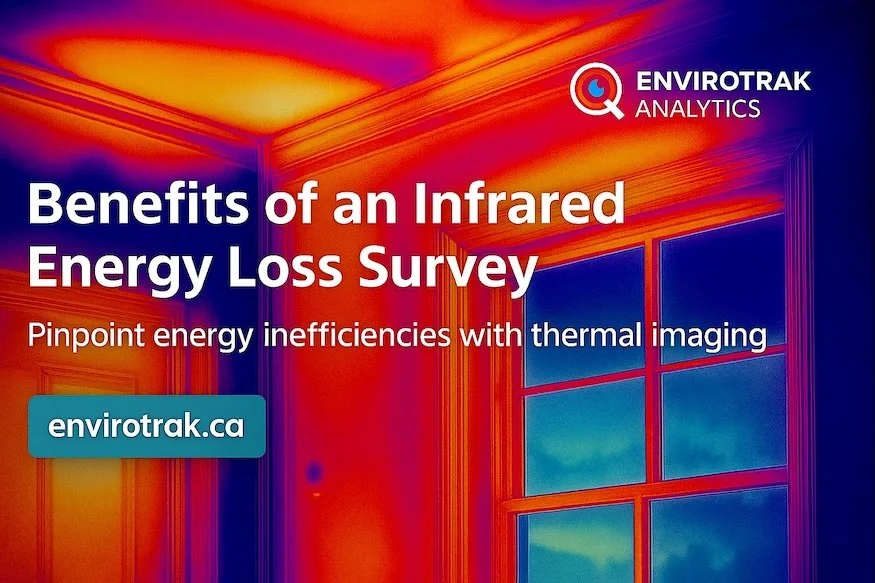
Advantages of An Infrared Energy Loss Survey for Your Home or Building
Heat Loss Is Costing You More Than You Think
Infrared Energy Loss Surveys are one of the smartest ways to uncover hidden inefficiencies in a home or commercial building. Using thermal imaging, we can pinpoint where conditioned air is escaping — long before it turns into higher utility bills or comfort complaints.
If you want to see what your building is really doing behind the walls, this is the place to start. Learn more at envirotrak.ca
Keeping your property energy-efficient isn’t just about saving money (though that’s certainly a perk). Hidden drafts, insulation gaps, and moisture intrusion can quietly undermine indoor comfort, damage building materials, and drive-up utility bills. The challenge? Most of these issues are invisible to the naked eye.
That’s where an Infrared Energy Loss Survey comes in—an advanced diagnostic service that uses thermal imaging to reveal precisely where your building is losing heat or conditioned air. At Envirotrak Analytics Ltd., we use professional-grade infrared cameras to give property owners a clear, science-backed picture of what’s happening behind the walls. Here are the key advantages:
Find Hidden Energy Loss Instantly
Infrared thermography identifies temperature differences across surfaces.
This lets us pinpoint:
Insulation gaps
Air leaks around windows, doors, and framing
Poorly sealed attic hatches
Hidden penetrations around plumbing and electrical lines
Problems that typically require guesswork—or worse, tearing open walls—are revealed quickly and non-invasively.
It’s like giving your building a pair of X-Ray goggles, but without the comic-book side effects.
Reduce Energy Bills (often significantly)
When warm indoor air escapes in winter or cool air leaks out in summer, your HVAC system has to work harder. By identifying and fixing these problem areas, owners often see measurable reductions on their monthly energy costs.
Correcting the issues highlighted during an infrared survey leads to:
Lower heating and cooling expenses
Less strain on equipment (longer lifespan)
Better building performance year-round
Improve Comfort for Occupants
Drafts, cold spots, uneven heating, and inexplicable “hot zones” aren’t mysteries—they’re symptoms. Infrared imaging shows you exactly where these comfort problems originate.
The result?
More consistent indoor temperature
Fewer complaints from tenants or family members
A quieter, more efficient HVAC system that isn’t constantly compensating
Detect Moisture Problems Before They Turn Into Big Repairs
Moisture intrusion often masquerades as energy loss. Wet insulation behaves differently under thermal imaging, making it easier to find early signs of:
Roof leaks
Foundation seepage
Window or flashing failures
Hidden condensation issues
Catching moisture early helps prevent mould growth, indoor air quality issues, and structural deterioration.
Confirm the Quality of Renovations or Upgrades
If you’ve recently upgraded insulation, windows, roofing, or HVAC systems, an infrared survey verifies that the work was done correctly—and that you’re actually getting the performance you paid for.
This is becoming increasingly popular for:
New construction
Post-renovation validation
Pre-purchase inspections
Commercial property assessments
Non-Destructive, Fast, and Ideal for Any Building Type
No drilling. No cutting holes. No shutting down operations.
Infrared surveys can be performed in homes, offices, commercial buildings, and multi-unit properties with minimal disruption. The process is relatively quick, clean, and highly informative.
Creates a Clear Roadmap for Improvements
The final report you receive from Envirotrak Analytics includes:
High-resolution thermal images
A detailed explanation of each identified issue
Specific recommendations for corrective action
Prioritized items based on energy impact and urgency
This turns guesswork into a smart, actionable plan.
Why Choose Envirotrak Analytics?
Envirotrak Analytics is equipped with professional-grade infrared imaging technology—including the FLIR E-Series platforms—paired with certified expertise in building diagnostics and indoor environmental health.
As Certified Infrared Moisture Surveyors and Certified Indoor Air Quality Test Technicians, we don’t just spot heat loss—we interpret what it means for the entire building system.
Final Thoughts
An Infrared Energy Loss Survey is one of the most cost-effective tools available for improving energy efficiency, comfort, and building performance. Whether you’re addressing high utility bills, preparing for upgrades, or simply trying to understand what’s happening inside your walls, thermal imaging provides clarity without the demolition.
If you’re in the Toronto GTA region and want to identify a building’s hidden inefficiencies Envirotrak Analytics can help. Visit envirotrak.ca to learn more or book your survey.
Radon Gas and Indoor Air Quality Testing in Homes and Offices
Radon Gas and Indoor Air Quality Testing in Homes and Offices
When most people think about indoor air quality (IAQ), they think about humidity, mould, or ventilation — but few realize that radon gas can be one of the most dangerous and invisible contaminants in the home or workplace.
Envirotrak’s certified technicians conduct testing under the same standards followed in Health Canada’s “Guide for Radon Measurements in Homes” (2025) and “Radon Guidance for Public Buildings” (2023).
Take Action Today!
Radon levels can vary significantly from one building to another — even within the same neighbourhood. Testing is the only way to know if you’re protected.
Book a professional Radon and IAQ assessment today at envirotrak.ca
When most people think about indoor air quality (IAQ), they think about humidity, mould, or ventilation — but few realize that radon gas can be one of the most dangerous and invisible contaminants in the home or workplace.
What is Radon Gas?
Radon is a naturally occurring, radioactive gas produced from the breakdown of uranium in soil and rock. It moves upward through the ground and can seep into buildings through cracks in foundations, sump pits, or openings around pipes. Because it is both invisible and odourless, the only way to know if your building has elevated radon levels is through testing.
According to Health Canada, long-term exposure to high levels of radon is the leading cause of lung cancer among non-smokers in Canada! The national guideline recommends taking corrective action in any building where averaged radon concentrations exceed 200 Bq/m³.
How Envirotrak Tests for Radon
At Envirotrak Analytics, we provide certified radon and indoor air quality testing services for homes, offices, and public buildings throughout the Greater Toronto Area and surrounding regions. Our testing approach aligns fully with Health Canada’s Radon Testing Guidelines (2025) and C-NRPP Quality Assurance protocols.
Our process typically includes two phases:
1. Short-Term Screening Test
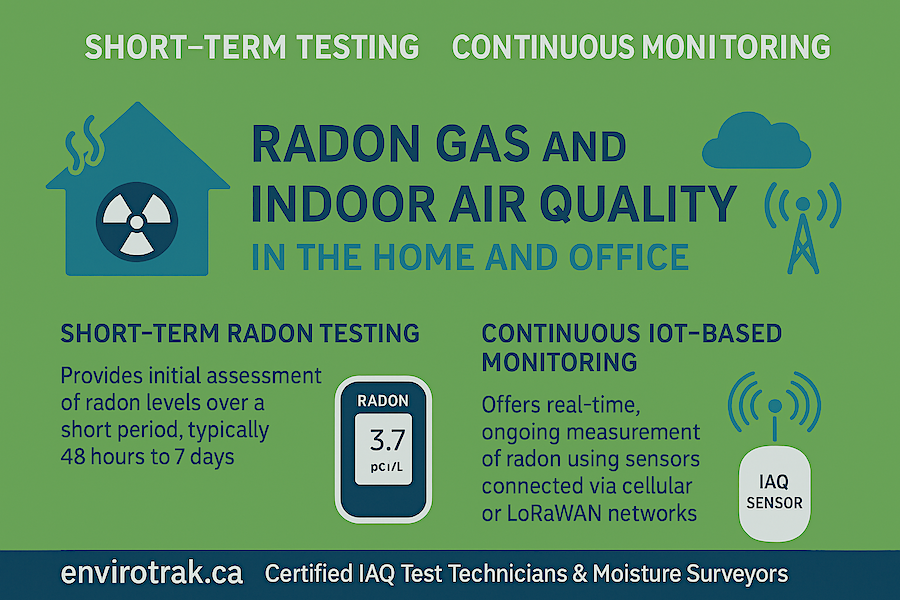
We begin with a short-term radon test to determine whether radon levels are high enough to justify a long-term follow-up. These preliminary tests help verify if your property shows early signs of radon infiltration and can be completed within a matter of days.
If results indicate elevated radon concentrations, we then move to the second stage.
2. Long-Term Measurement or Continuous Monitoring
As per Health Canada and for more accurate results over time, we perform long-term testing using continuous electronic radon monitors (ERMs) that are C-NRPP approved and meet Canadian measurement standards. These devices log hourly data and provide detailed profiles of radon fluctuations that are averaged over time, about 91 days or more in some cases.
Envirotrak does offer continuous remote radon monitoring using cellular or LoRaWAN-enabled ERM devices — ideal for commercial buildings, property managers, or government facilities that require automated, real-time datacollection and trend reporting. This networked monitoring ensures reliable long-term verification and compliance documentation.
Why Professional Radon Testing Matters
Do-it-yourself test kits are widely available but require lab analysis, however, professional testing ensures:
Proper device calibration and placement, as required by Health Canada and C-NRPP protocols
Validated data quality and traceable accuracy
Detailed analytical reporting to guide mitigation decisions
Integration with IAQ testing for other pollutants such as CO2, VOCs, and humidity
Envirotrak’s certified technicians conduct radon gas testing under the same standards followed in Health Canada’s “Guide for Radon Measurements in Homes” (2025) and “Radon Guidance for Public Buildings” (2023).
Envirotrak’s certified technicians conduct testing under the same standards followed in Health Canada’s “Guide for Radon Measurements in Homes” (2025) and “Radon Guidance for Public Buildings” (2023).
Take Action Today!
Radon levels can vary significantly from one building to another — even within the same neighbourhood. Testing is the only way to know if you’re protected.
Envirotrak Analytics Ltd. provides:
Certified Radon Gas Testing
Short-Term and Long-Term Measurement
Continuous Cellular or LoRaWAN ERM Monitoring
Full Indoor Air Quality (IAQ) Testing and Analysis
We’re Certified Indoor Air Quality Test Technicians and Certified Infrared Moisture Surveyors, serving homeowners, offices, and public facilities across the Toronto GTA.
✅ Book a professional Radon and IAQ assessment today at envirotrak.ca
Understanding VOCs: Why Indoor Air Quality Testing Matters in Homes and Offices
Understanding VOCs: Why Indoor Air Quality Testing Matters in Homes and Offices:
Everyday materials can silently release chemicals into the air we breathe — and these volatile organic compounds (VOCs) can significantly impact our health and indoor air quality.
VOCs are gases emitted from certain solids and liquids, commonly found in products we use daily. Paints, cleaning agents, adhesives, carpets, furniture, office equipment, and even air fresheners can release VOCs into indoor air. Because Canadians spend close to 90% of their time indoors, exposure levels can build up far beyond outdoor concentrations, particularly in newer or tightly sealed buildings designed for energy efficiency.
Envirotrak Analytics Ltd. offers certified indoor air quality testing and VOC analysis for both residential and commercial clients. Using modern calibrated instrumentation and accredited lab testing where required, our team identifies sources of VOCs and other airborne contaminants to ensure your home or workplace meets recognized indoor air quality standards.
Whether you’re experiencing odours, headaches, or simply want peace of mind about your air quality, a VOC assessment can reveal what’s in the air you breathe and how to make it healthier.
Everyday materials can silently release chemicals into the air we breathe — and these volatile organic compounds (VOCs) can significantly impact our health and indoor air quality.
VOCs are gases emitted from certain solids and liquids, commonly found in products we use daily. Paints, cleaning agents, adhesives, carpets, furniture, office equipment, and even air fresheners can release VOCs into indoor air. Because Canadians spend close to 90% of their time indoors, exposure levels can build up far beyond outdoor concentrations, particularly in newer or tightly sealed buildings designed for energy efficiency.
Common Sources of VOCs Indoors
According to Health Canada and the U.S. Environmental Protection Agency (EPA), VOCs are released from:
Paints, varnishes, and solvents
Common building materials, e.g., laminates, plywood, fibreboard, vinyl, and furnishings
Cleaning products and disinfectants
Office printers, copiers, and adhesives
Scented products like candles and air fresheners
Stored fuels and automotive products
Even at low levels, prolonged exposure to VOCs can cause eye, nose, and throat irritation, headaches, dizziness, and nausea. Some VOCs, such as formaldehyde and benzene, are known or suspected human carcinogens.
How VOC Testing Improves Indoor Air Quality
Professional VOC testing provides measurable insight into what’s circulating in your indoor environment. Using advanced scientific sampling instruments, certified indoor air quality technicians identify both specific VOCs and total VOC concentrations (TVOCs) to help assess:
Whether levels exceed Health Canada’s or ASHRAE’s recommended limits
If building materials or furnishings are off-gassing pollutants
The impact of ventilation systems on chemical buildup
The effectiveness of remediation or filtration efforts
Results are interpreted alongside other IAQ factors — such as carbon dioxide, humidity, particulate matter, and ventilation rates — to form a complete picture of your indoor environment.
Creating a Healthier Indoor Environment
Reducing VOC exposure involves both testing and proactive management:
Increase ventilation: Open windows or improve mechanical ventilation where possible.
Choose low-emission products: Look for paints, adhesives, and furnishings labeled “low-VOC” or “no-VOC.
Avoid overuse of fragranced or aerosol products.
Maintain temperature and humidity within optimal ranges (per ASHRAE 62.1 and 62.2 standards).
Store chemicals safely and dispose of old or unused products properly.
For office environments, Health Canada’s Guidance on Improving Indoor Air Quality in Office Buildings (2025) highlights that regular air quality monitoring and HVAC maintenance are essential to minimizing VOC accumulation and protecting occupant comfort and productivity.
Professional VOC Testing in the Toronto GTA
Envirotrak Analytics Ltd. offers certified indoor air quality testing and VOC analysis for both residential and commercial clients. Using modern calibrated instrumentation and accredited lab testing where required, our team identifies sources of VOCs and other airborne contaminants to ensure your home or workplace meets recognized indoor air quality standards.
Whether you’re experiencing odours, headaches, or simply want peace of mind about your air quality, a VOC assessment can reveal what’s in the air you breathe and how to make it healthier.
Envirotrak Analytics Ltd.
Certified Indoor Air Quality Test Technicians
Certified Infrared Moisture Surveyors
📍 Serving Toronto and the Greater Toronto Area
🌐 envirotrak.ca
Why You Should Assess Indoor Air Quality During and After Construction or Renovation
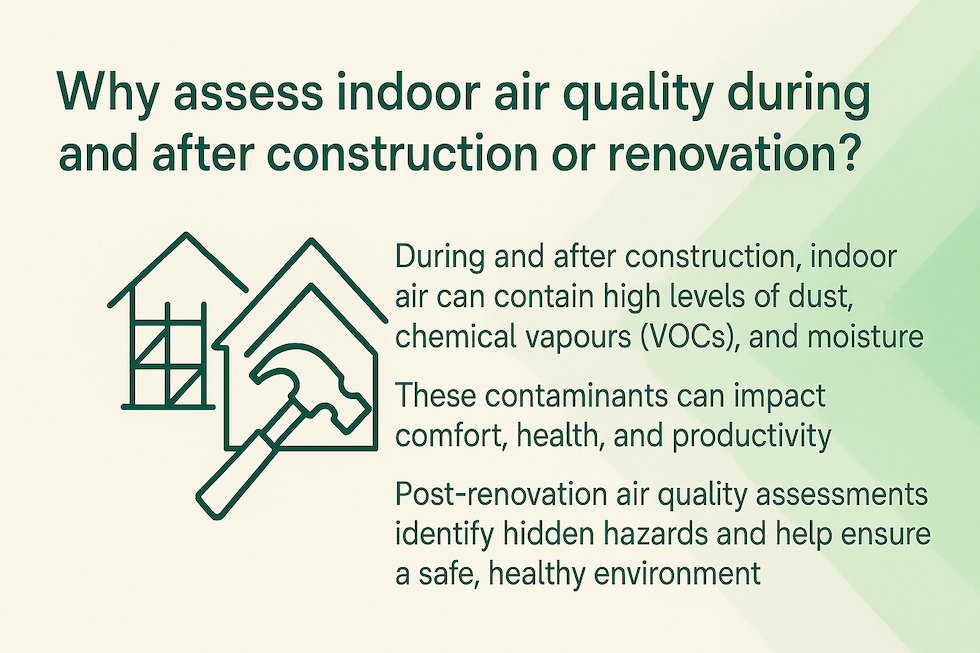
Whether you’re building a new home, upgrading an office space, or completing a major renovation, indoor air quality (IAQ) should be a top priority. During and after construction, airborne contaminants can accumulate to levels that affect health, comfort, and productivity if they’re not properly identified and controlled.
Why Testing Matters
Poor indoor air quality doesn’t just create temporary odours or discomfort. It can cause eye, nose, and throat irritation, fatigue, and respiratory symptoms — especially in people with asthma or allergies. Health Canada and ASHRAE (Standards 62.1 and 62.2) emphasize that proper ventilation and post-construction air testing are critical for maintaining healthy indoor environments.
Whether you’re building a new home, upgrading an office space, or completing a major renovation, indoor air quality (IAQ) should be a top priority. During and after construction, airborne contaminants can accumulate to levels that affect health, comfort, and productivity if they’re not properly identified and controlled.
Construction Dust and Chemical Emissions
According to Health Canada’s Guidance for Indoor Air Quality Professionals (2025), construction and renovation projects can release a variety of pollutants — including fine particulate matter (PM 2.5), formaldehyde, volatile organic compounds (VOCs), and carbon monoxide (CO).
These contaminants originate from:
New building materials such as flooring (all types), paints, sealants, adhesives, and insulation.
Dust and debris from drywall sanding, concrete cutting, demolition and Asbestos fibres from old plaster and pipe insulation removal.
Combustion byproducts from equipment and tools powered by gas or diesel.
Moisture accumulation, which can lead to mould growth if surfaces are not properly dried.
Why Testing Matters
Poor indoor air quality doesn’t just create temporary odours or discomfort. It can cause eye, nose, and throat irritation, fatigue, and respiratory symptoms — especially in people with asthma or allergies. Health Canada and ASHRAE (Standards 62.1 and 62.2) emphasize that proper ventilation and post-construction air testing are critical for maintaining healthy indoor environments.
Post-Renovation IAQ Assessment Steps
After construction or renovation, a certified Indoor Air Quality Test Technician (CIAQTT) should:
Measure airborne particulate and chemical pollutants, including VOCs, carbon monoxide, and formaldehyde.
Check ventilation performance against ASHRAE standards for airflow and filtration efficiency.
Inspect for hidden moisture or mould using infrared thermography and moisture mapping techniques.
Verify occupant safety by ensuring contaminant levels meet Health Canada exposure guidelines.
How Envirotrak Analytics Can Help
At Envirotrak Analytics Ltd., our Certified Indoor Air Quality Test Technicians and Certified Infrared Moisture Surveyors provide comprehensive IAQ assessments for homes and offices across the Toronto GTA and surrounding regions.
We use calibrated instruments and can deploy real-time monitoring to identify hidden air quality hazards and provide data-driven, action-based recommendations to ensure your space is healthy, compliant, and comfortable.
Protect your investment — and your health — by scheduling an indoor air quality assessment before moving back in.
📍 Visit envirotrak.ca to learn more or book a professional IAQ inspection.
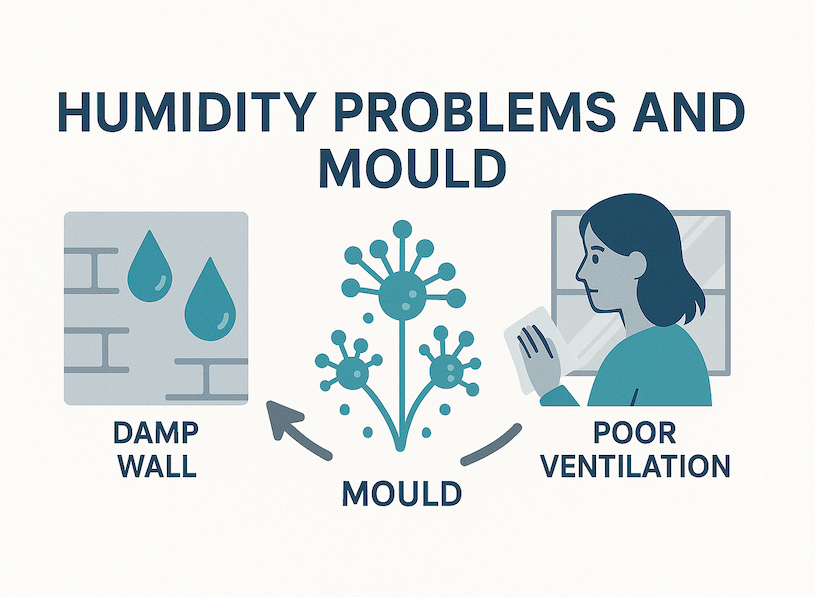
When the Air Feels “Heavy”: How High Humidity Hurts Indoor Air Quality (and How to Fix It)
When the Air Feels “Heavy”: How High Humidity Hurts Indoor Air Quality (and How to Fix It)
Why Humidity Matters
Relative humidity (RH) is more than a comfort factor—it’s a cornerstone of indoor air quality. When RH levels rise above 50–60%, homes and offices become breeding grounds for mould, bacteria, and dust mites. Health Canada and ASHRAE emphasize that excess humidity doesn’t just make a space feel muggy—it directly contributes to poor IAQ and health problems.
Indoor Air Problems Linked to High Humidity
Mould Growth: Damp drywall, carpets, or insulation can quickly host mould colonies. Some moulds produce allergens or even mycotoxins that aggravate asthma, allergies, and respiratory conditions.
Musty Odours & Staining: Persistent dampness leads to odours, peeling paint, and warped wood surfaces.
Allergic & Respiratory Issues: Occupants exposed to mould and dampness often report coughing, wheezing, throat irritation, and worsening of asthma.
Building Damage: Excess humidity can weaken structural materials, corrode metal, and promote rot.
Why Offices and Homes Are Vulnerable
Sealed, Energy-Efficient Buildings: Tightly sealed spaces trap moisture indoors if ventilation isn’t properly managed.
Everyday Activities: Cooking, showering, and even breathing add litres of water vapor into the air daily.
HVAC Issues: Poorly maintained systems may recirculate moisture instead of removing it.
Solutions: How to Take Control of Humidity
Keep RH Between 30–50% ✅
Use a hygrometer to track indoor humidity.
Dehumidifiers are effective in basements and damp areas.
Ventilation is Key ✅
Install and use exhaust fans in bathrooms and kitchens that vent outside—not into the attic or wall cavity, which is against building code standards.
Consider heat recovery or energy recovery ventilators (HRVs/ERVs) for modern, airtight buildings.
Moisture Source Control ✅
Repair plumbing leaks immediately.
Ensure eavestroughs and downspouts direct water away from the foundation.
Improve grading so water drains away from the building.
Regular Maintenance ✅
Clean and maintain HVAC systems, especially drip pans and humidifiers.
Use moisture-resistant finishes in kitchens, bathrooms, and laundry areas.
Professional Help for Persistent Issues ✅
If mould is visible or suspected behind walls, hire qualified IAQ professionals.
Certified technicians can conduct moisture surveys, microbial sampling, and remediation verification.
Final Takeaway
High humidity is often overlooked until it becomes a problem—but by the time you smell musty odours or see visible mould, damage has already started. Keeping your indoor RH in the healthy range (30–50%) is one of the simplest, most effective ways to protect your health, comfort, and property.
👉 If you’re concerned about indoor humidity and air quality, Envirotrak Analytics Ltd. provides certified moisture surveys, certified indoor air quality testing, and professional reporting so you can take action before issues escalate.
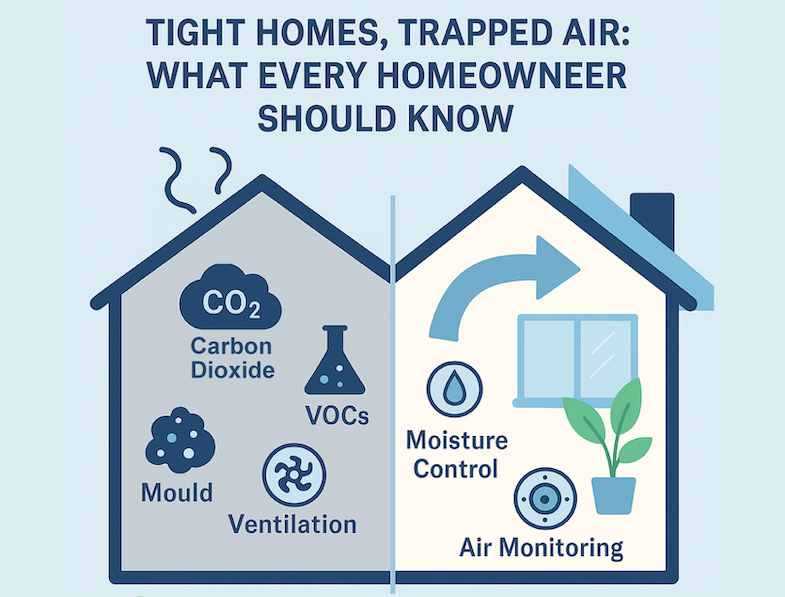
Sealed In and Stuffy: The Hidden Air Problems of Tight Homes
Sealed In and Stuffy: The Hidden Air Problems of Tight Homes.
Energy efficiency has become the gold standard in modern home design. Builders and homeowners alike are sealing up cracks, upgrading insulation, and installing high-performance windows to lock in comfort and lock out wasted energy. On paper, it’s a win for both your wallet and the environment.
But here’s the twist: a home can actually be too efficient. When your house is sealed too tightly, you may end up trading lower utility bills for stale, unhealthy air.
When Fresh Air Can’t Get In
Older homes were drafty by design. Gaps around doors, windows, and walls may have wasted energy, but they also let in a steady supply of outdoor air. In today’s “tight” homes, natural ventilation is limited, and that can mean trouble.
Without enough fresh air, indoor pollutants build up quickly:
Carbon dioxide (CO₂) from everyday breathing leaves the air feeling stuffy and heavy.
Volatile Organic Compounds (VOCs), released from paints, furniture, and cleaners, linger longer and in higher concentrations.
Moisture and mould thrive in sealed spaces with poor airflow.
Dust, pet dander, and allergens circulate endlessly without proper filtration.
Radon gas, a natural radioactive gas that seeps in from the ground, can accumulate to unsafe levels, which can cause severe health issues.
The result? A home that looks spotless and efficient from the outside but feels stale and sometimes even unhealthy on the inside.
How It Affects You and Your Family
Poor indoor air quality doesn’t always show up as an obvious problem. Instead, it sneaks into your daily life: the morning headaches, the mid-afternoon fatigue, or the worsening of allergies and asthma. Over time, these exposures may increase risks for more serious health issues like cardiovascular disease or chronic respiratory problems.
As Health Canada and ASHRAE (leading indoor air quality standard-setting body) both remind us: efficiency should never come at the expense of breathable, healthy indoor air.
Striking the Right Balance
The good news? You don’t need to choose between efficiency and fresh air—you can have both. Here’s how:
Bring in fresh air, the smart way. Heat Recovery Ventilators (HRVs) and Energy Recovery Ventilators (ERVs) let outdoor air in while conserving energy.
Control moisture. Keep humidity between 30–50% to discourage mould while maintaining comfort.
Filter what you can’t see. Upgrade to a higher-efficiency furnace filter (MERV 13 if possible) or add portable HEPA purifiers in bedrooms and living areas.
Test and monitor. A radon test kit is a must for every Canadian home. Indoor air sensors can also track humidity, CO₂, and pollutant levels in real time.
Be mindful of pollutants. Store paints and solvents in the garage, choose low-emission furniture and finishes, and have appliances serviced regularly.
Breathe Easy in Your Tight Home
A tightly sealed home doesn’t have to mean poor air quality. With the right ventilation and clean-air practices, you can enjoy both lower energy bills and a healthier living space.
At Envirotrak Analytics Ltd., we help homeowners identify, monitor, and solve indoor air quality challenges—so your home can be both energy-smart and safe for every breath you take.