
Understanding VOCs: Why Indoor Air Quality Testing Matters in Homes and Offices
Understanding VOCs: Why Indoor Air Quality Testing Matters in Homes and Offices:
Everyday materials can silently release chemicals into the air we breathe — and these volatile organic compounds (VOCs) can significantly impact our health and indoor air quality.
VOCs are gases emitted from certain solids and liquids, commonly found in products we use daily. Paints, cleaning agents, adhesives, carpets, furniture, office equipment, and even air fresheners can release VOCs into indoor air. Because Canadians spend close to 90% of their time indoors, exposure levels can build up far beyond outdoor concentrations, particularly in newer or tightly sealed buildings designed for energy efficiency.
Envirotrak Analytics Ltd. offers certified indoor air quality testing and VOC analysis for both residential and commercial clients. Using modern calibrated instrumentation and accredited lab testing where required, our team identifies sources of VOCs and other airborne contaminants to ensure your home or workplace meets recognized indoor air quality standards.
Whether you’re experiencing odours, headaches, or simply want peace of mind about your air quality, a VOC assessment can reveal what’s in the air you breathe and how to make it healthier.
Everyday materials can silently release chemicals into the air we breathe — and these volatile organic compounds (VOCs) can significantly impact our health and indoor air quality.
VOCs are gases emitted from certain solids and liquids, commonly found in products we use daily. Paints, cleaning agents, adhesives, carpets, furniture, office equipment, and even air fresheners can release VOCs into indoor air. Because Canadians spend close to 90% of their time indoors, exposure levels can build up far beyond outdoor concentrations, particularly in newer or tightly sealed buildings designed for energy efficiency.
Common Sources of VOCs Indoors
According to Health Canada and the U.S. Environmental Protection Agency (EPA), VOCs are released from:
Paints, varnishes, and solvents
Common building materials, e.g., laminates, plywood, fibreboard, vinyl, and furnishings
Cleaning products and disinfectants
Office printers, copiers, and adhesives
Scented products like candles and air fresheners
Stored fuels and automotive products
Even at low levels, prolonged exposure to VOCs can cause eye, nose, and throat irritation, headaches, dizziness, and nausea. Some VOCs, such as formaldehyde and benzene, are known or suspected human carcinogens.
How VOC Testing Improves Indoor Air Quality
Professional VOC testing provides measurable insight into what’s circulating in your indoor environment. Using advanced scientific sampling instruments, certified indoor air quality technicians identify both specific VOCs and total VOC concentrations (TVOCs) to help assess:
Whether levels exceed Health Canada’s or ASHRAE’s recommended limits
If building materials or furnishings are off-gassing pollutants
The impact of ventilation systems on chemical buildup
The effectiveness of remediation or filtration efforts
Results are interpreted alongside other IAQ factors — such as carbon dioxide, humidity, particulate matter, and ventilation rates — to form a complete picture of your indoor environment.
Creating a Healthier Indoor Environment
Reducing VOC exposure involves both testing and proactive management:
Increase ventilation: Open windows or improve mechanical ventilation where possible.
Choose low-emission products: Look for paints, adhesives, and furnishings labeled “low-VOC” or “no-VOC.
Avoid overuse of fragranced or aerosol products.
Maintain temperature and humidity within optimal ranges (per ASHRAE 62.1 and 62.2 standards).
Store chemicals safely and dispose of old or unused products properly.
For office environments, Health Canada’s Guidance on Improving Indoor Air Quality in Office Buildings (2025) highlights that regular air quality monitoring and HVAC maintenance are essential to minimizing VOC accumulation and protecting occupant comfort and productivity.
Professional VOC Testing in the Toronto GTA
Envirotrak Analytics Ltd. offers certified indoor air quality testing and VOC analysis for both residential and commercial clients. Using modern calibrated instrumentation and accredited lab testing where required, our team identifies sources of VOCs and other airborne contaminants to ensure your home or workplace meets recognized indoor air quality standards.
Whether you’re experiencing odours, headaches, or simply want peace of mind about your air quality, a VOC assessment can reveal what’s in the air you breathe and how to make it healthier.
Envirotrak Analytics Ltd.
Certified Indoor Air Quality Test Technicians
Certified Infrared Moisture Surveyors
📍 Serving Toronto and the Greater Toronto Area
🌐 envirotrak.ca
Sealed In and Stuffy: The Hidden Air Problems of Tight Homes
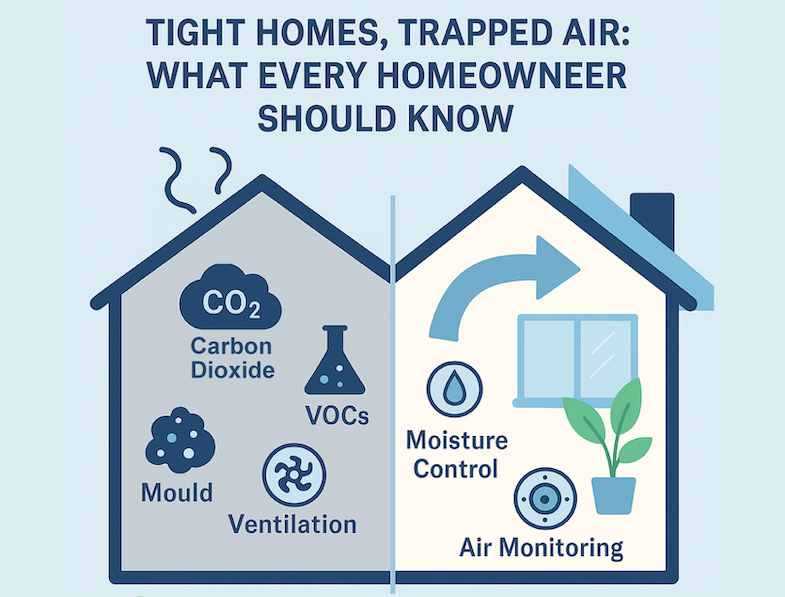
Sealed In and Stuffy: The Hidden Air Problems of Tight Homes.
Energy efficiency has become the gold standard in modern home design. Builders and homeowners alike are sealing up cracks, upgrading insulation, and installing high-performance windows to lock in comfort and lock out wasted energy. On paper, it’s a win for both your wallet and the environment.
But here’s the twist: a home can actually be too efficient. When your house is sealed too tightly, you may end up trading lower utility bills for stale, unhealthy air.
When Fresh Air Can’t Get In
Older homes were drafty by design. Gaps around doors, windows, and walls may have wasted energy, but they also let in a steady supply of outdoor air. In today’s “tight” homes, natural ventilation is limited, and that can mean trouble.
Without enough fresh air, indoor pollutants build up quickly:
Carbon dioxide (CO₂) from everyday breathing leaves the air feeling stuffy and heavy.
Volatile Organic Compounds (VOCs), released from paints, furniture, and cleaners, linger longer and in higher concentrations.
Moisture and mould thrive in sealed spaces with poor airflow.
Dust, pet dander, and allergens circulate endlessly without proper filtration.
Radon gas, a natural radioactive gas that seeps in from the ground, can accumulate to unsafe levels, which can cause severe health issues.
The result? A home that looks spotless and efficient from the outside but feels stale and sometimes even unhealthy on the inside.
How It Affects You and Your Family
Poor indoor air quality doesn’t always show up as an obvious problem. Instead, it sneaks into your daily life: the morning headaches, the mid-afternoon fatigue, or the worsening of allergies and asthma. Over time, these exposures may increase risks for more serious health issues like cardiovascular disease or chronic respiratory problems.
As Health Canada and ASHRAE (leading indoor air quality standard-setting body) both remind us: efficiency should never come at the expense of breathable, healthy indoor air.
Striking the Right Balance
The good news? You don’t need to choose between efficiency and fresh air—you can have both. Here’s how:
Bring in fresh air, the smart way. Heat Recovery Ventilators (HRVs) and Energy Recovery Ventilators (ERVs) let outdoor air in while conserving energy.
Control moisture. Keep humidity between 30–50% to discourage mould while maintaining comfort.
Filter what you can’t see. Upgrade to a higher-efficiency furnace filter (MERV 13 if possible) or add portable HEPA purifiers in bedrooms and living areas.
Test and monitor. A radon test kit is a must for every Canadian home. Indoor air sensors can also track humidity, CO₂, and pollutant levels in real time.
Be mindful of pollutants. Store paints and solvents in the garage, choose low-emission furniture and finishes, and have appliances serviced regularly.
Breathe Easy in Your Tight Home
A tightly sealed home doesn’t have to mean poor air quality. With the right ventilation and clean-air practices, you can enjoy both lower energy bills and a healthier living space.
At Envirotrak Analytics Ltd., we help homeowners identify, monitor, and solve indoor air quality challenges—so your home can be both energy-smart and safe for every breath you take.