
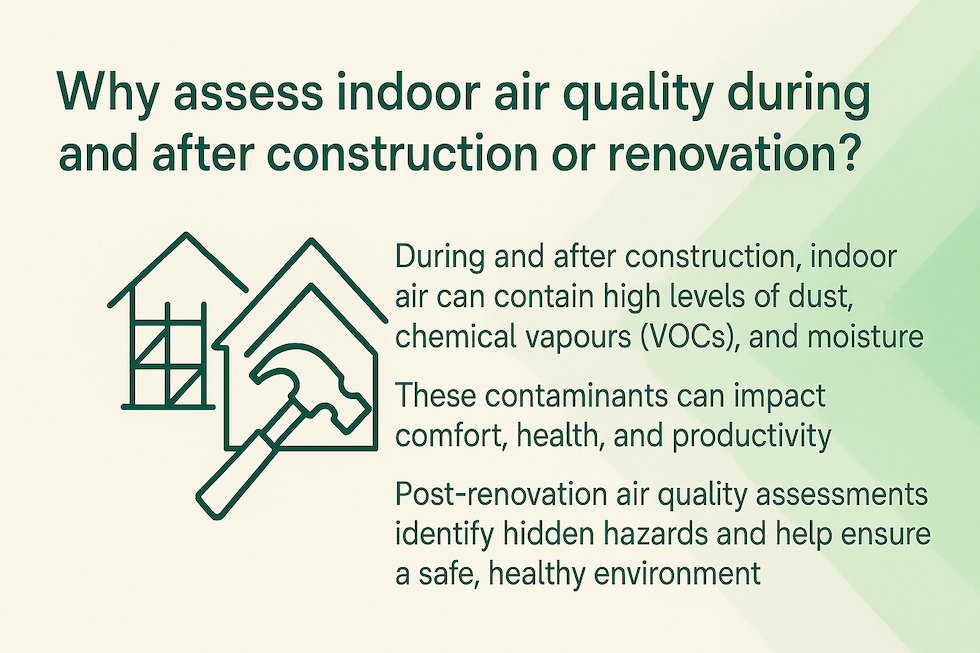
Why You Should Assess Indoor Air Quality During and After Construction or Renovation
Whether you’re building a new home, upgrading an office space, or completing a major renovation, indoor air quality (IAQ) should be a top priority. During and after construction, airborne contaminants can accumulate to levels that affect health, comfort, and productivity if they’re not properly identified and controlled.
Why Testing Matters
Poor indoor air quality doesn’t just create temporary odours or discomfort. It can cause eye, nose, and throat irritation, fatigue, and respiratory symptoms — especially in people with asthma or allergies. Health Canada and ASHRAE (Standards 62.1 and 62.2) emphasize that proper ventilation and post-construction air testing are critical for maintaining healthy indoor environments.
Whether you’re building a new home, upgrading an office space, or completing a major renovation, indoor air quality (IAQ) should be a top priority. During and after construction, airborne contaminants can accumulate to levels that affect health, comfort, and productivity if they’re not properly identified and controlled.
Construction Dust and Chemical Emissions
According to Health Canada’s Guidance for Indoor Air Quality Professionals (2025), construction and renovation projects can release a variety of pollutants — including fine particulate matter (PM 2.5), formaldehyde, volatile organic compounds (VOCs), and carbon monoxide (CO).
These contaminants originate from:
New building materials such as flooring (all types), paints, sealants, adhesives, and insulation.
Dust and debris from drywall sanding, concrete cutting, demolition and Asbestos fibres from old plaster and pipe insulation removal.
Combustion byproducts from equipment and tools powered by gas or diesel.
Moisture accumulation, which can lead to mould growth if surfaces are not properly dried.
Why Testing Matters
Poor indoor air quality doesn’t just create temporary odours or discomfort. It can cause eye, nose, and throat irritation, fatigue, and respiratory symptoms — especially in people with asthma or allergies. Health Canada and ASHRAE (Standards 62.1 and 62.2) emphasize that proper ventilation and post-construction air testing are critical for maintaining healthy indoor environments.
Post-Renovation IAQ Assessment Steps
After construction or renovation, a certified Indoor Air Quality Test Technician (CIAQTT) should:
Measure airborne particulate and chemical pollutants, including VOCs, carbon monoxide, and formaldehyde.
Check ventilation performance against ASHRAE standards for airflow and filtration efficiency.
Inspect for hidden moisture or mould using infrared thermography and moisture mapping techniques.
Verify occupant safety by ensuring contaminant levels meet Health Canada exposure guidelines.
How Envirotrak Analytics Can Help
At Envirotrak Analytics Ltd., our Certified Indoor Air Quality Test Technicians and Certified Infrared Moisture Surveyors provide comprehensive IAQ assessments for homes and offices across the Toronto GTA and surrounding regions.
We use calibrated instruments and can deploy real-time monitoring to identify hidden air quality hazards and provide data-driven, action-based recommendations to ensure your space is healthy, compliant, and comfortable.
Protect your investment — and your health — by scheduling an indoor air quality assessment before moving back in.
📍 Visit envirotrak.ca to learn more or book a professional IAQ inspection.
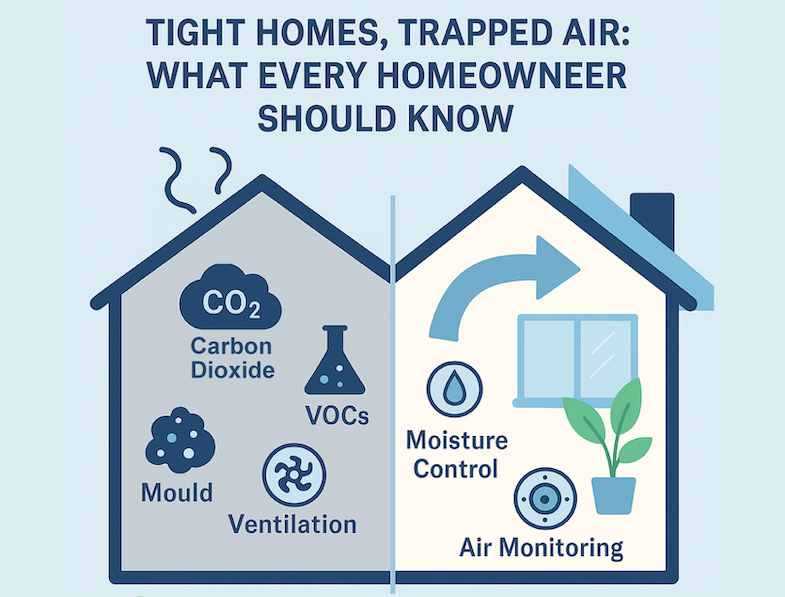
Sealed In and Stuffy: The Hidden Air Problems of Tight Homes
Sealed In and Stuffy: The Hidden Air Problems of Tight Homes.
Energy efficiency has become the gold standard in modern home design. Builders and homeowners alike are sealing up cracks, upgrading insulation, and installing high-performance windows to lock in comfort and lock out wasted energy. On paper, it’s a win for both your wallet and the environment.
But here’s the twist: a home can actually be too efficient. When your house is sealed too tightly, you may end up trading lower utility bills for stale, unhealthy air.
When Fresh Air Can’t Get In
Older homes were drafty by design. Gaps around doors, windows, and walls may have wasted energy, but they also let in a steady supply of outdoor air. In today’s “tight” homes, natural ventilation is limited, and that can mean trouble.
Without enough fresh air, indoor pollutants build up quickly:
Carbon dioxide (CO₂) from everyday breathing leaves the air feeling stuffy and heavy.
Volatile Organic Compounds (VOCs), released from paints, furniture, and cleaners, linger longer and in higher concentrations.
Moisture and mould thrive in sealed spaces with poor airflow.
Dust, pet dander, and allergens circulate endlessly without proper filtration.
Radon gas, a natural radioactive gas that seeps in from the ground, can accumulate to unsafe levels, which can cause severe health issues.
The result? A home that looks spotless and efficient from the outside but feels stale and sometimes even unhealthy on the inside.
How It Affects You and Your Family
Poor indoor air quality doesn’t always show up as an obvious problem. Instead, it sneaks into your daily life: the morning headaches, the mid-afternoon fatigue, or the worsening of allergies and asthma. Over time, these exposures may increase risks for more serious health issues like cardiovascular disease or chronic respiratory problems.
As Health Canada and ASHRAE (leading indoor air quality standard-setting body) both remind us: efficiency should never come at the expense of breathable, healthy indoor air.
Striking the Right Balance
The good news? You don’t need to choose between efficiency and fresh air—you can have both. Here’s how:
Bring in fresh air, the smart way. Heat Recovery Ventilators (HRVs) and Energy Recovery Ventilators (ERVs) let outdoor air in while conserving energy.
Control moisture. Keep humidity between 30–50% to discourage mould while maintaining comfort.
Filter what you can’t see. Upgrade to a higher-efficiency furnace filter (MERV 13 if possible) or add portable HEPA purifiers in bedrooms and living areas.
Test and monitor. A radon test kit is a must for every Canadian home. Indoor air sensors can also track humidity, CO₂, and pollutant levels in real time.
Be mindful of pollutants. Store paints and solvents in the garage, choose low-emission furniture and finishes, and have appliances serviced regularly.
Breathe Easy in Your Tight Home
A tightly sealed home doesn’t have to mean poor air quality. With the right ventilation and clean-air practices, you can enjoy both lower energy bills and a healthier living space.
At Envirotrak Analytics Ltd., we help homeowners identify, monitor, and solve indoor air quality challenges—so your home can be both energy-smart and safe for every breath you take.